
Compliance
Evidence, not a transcription exercise
The point of modelling the register on the standards is that you can show the tool to an auditor rather than exporting it into a separate spreadsheet and reformatting it the week before the visit.
Why it holds up
Three properties an auditor tends to probe
Can the record have been edited after the fact?
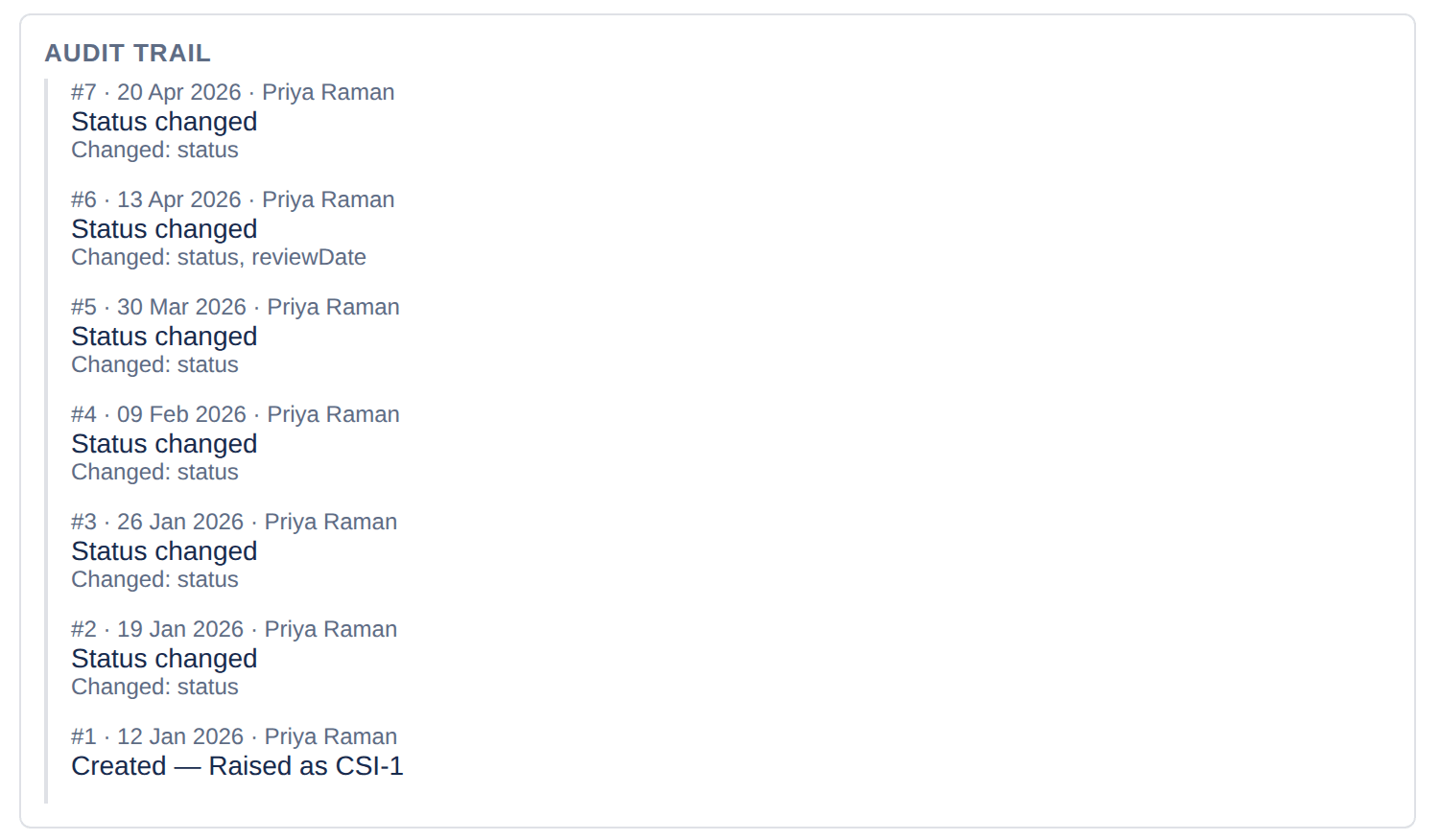
The audit trail is append-only. There is no update path and no delete path for an event. Only a project administrator deleting an entire improvement removes its history, and the deletion itself is recorded — which improvement, who, and when — in a deletion log on the project's settings page.
Could an event be missing?
Each improvement's events carry a monotonic sequence number. Two events written in the same millisecond still have a defined order, and a gap in the sequence is detectable rather than invisible.
Is the benefit figure real?
Realised benefit is counted only from verified and closed records, verification requires evidence, and verification cannot be reached without implementation. The lifecycle enforces the claim.
ISO/IEC 20000-1:2018
Service management system
| Clause | Title | How ImproveDesk serves it |
|---|---|---|
| 10.2 | Continual improvement | The register itself. Opportunities are recorded with a source, evaluated against documented criteria (RICE and the composite score), prioritised, actioned through the lifecycle and verified before closure. |
| 9.3 | Management review | The dashboard is the review pack: open and overdue counts, realisation rate, return on cost, median cycle time, raised against closed over twelve months, and the ageing of open work. |
| 8.6.3 | Problem management | Improvements sourced from incidents, major incident reviews and problems, with the delivery issues that implement them linked from Jira. |
| 9.1 | Monitoring and measurement | Baseline, target and actual per measure, with lower-is-better handled correctly, and a weekly snapshot that preserves the figures over time. |
ISO/IEC 27001:2022
Information security management system
| Clause | Title | How ImproveDesk serves it |
|---|---|---|
| 10.1 | Continual improvement | The same register serves the ISMS. Tag improvements with the clause or control you are evidencing. |
| 10.2 | Nonconformity and corrective action | Audit findings are a first-class source. The record captures the finding, the correction, the owner, the target date and the verification that it worked — with dates that cannot be back-fitted. |
| 9.2 | Internal audit | "Internal audit" and "external audit" are sources on the record, so audit-driven work is reportable separately from service-driven work. |
ITIL 4
The seven-step continual improvement model
The record is shaped so that each step of the model has somewhere to live, rather than being a discipline people are asked to remember.
| Step | Question | Where it lives in the record |
|---|---|---|
| Step 1 | What is the vision? | Sponsor and benefit narrative on every record. |
| Step 2 | Where are we now? | Baseline captured per measure. |
| Step 3 | Where do we want to be? | Target per measure, and a target date. |
| Step 4 | How do we get there? | Linked Jira delivery issues, risks and dependencies. |
| Step 5 | Take action | Approved and In progress, with an owner accountable. |
| Step 6 | Did we get there? | Actual per measure, realised benefit, and the Verified gate. |
| Step 7 | How do we keep the momentum? | Review cadence, the daily attention sweep and the weekly snapshot. |
An honest note on clause references
Standard references on a record are free text. That is deliberate — a fixed clause list goes stale with every revision of a standard, and a tool that ships one quietly becomes wrong. The trade-off is real: ImproveDesk cannot validate your references against a controlled clause set, so pick a convention and apply it. The clause numbers on this page are given to show intent, and you should confirm them against your own certification scope and the current text of the standard.
What ImproveDesk is not
It is not a certification, an assessment, or a guarantee that you will pass an audit. It is a register that records improvement work in a form an auditor can read, with controls that stop the most common ways such a register becomes untrustworthy. The judgement remains yours and your auditor's.
Where the data actually lives
A fair question before any compliance conversation. The answer is short: inside your own Atlassian tenancy — and, only if you switch on the email digest, in the inboxes of the people you send it to.